
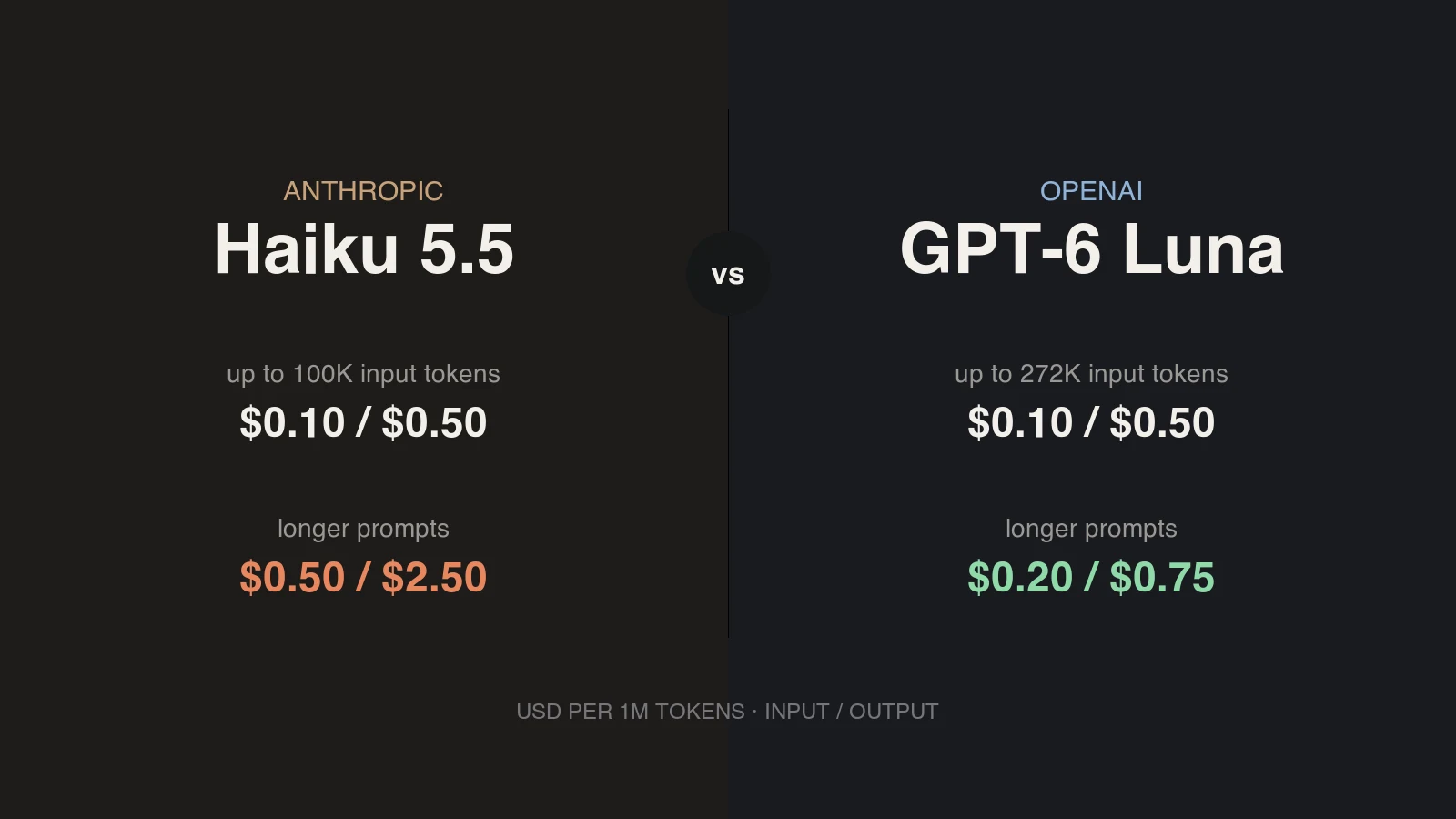

Claude Haiku 5.5 is the smarter of the two small models. GPT-6 Luna is usually the cheaper one to run. They share the same sticker price, and the difference shows up in the bill.
- Pick Haiku 5.5 for agents that browse or operate a computer, and for short prompts where accuracy matters more than a few cents.
- Pick GPT-6 Luna for prompts longer than 100K tokens and for high-volume jobs where cost per task is the number your team watches.
Updated October 9, 2026. Prices in USD per million tokens.
Claude Haiku 5.5 vs GPT-6 Luna at a glance
| Claude Haiku 5.5 | GPT-6 Luna | |
|---|---|---|
| Released | October 7, 2026 | September 22, 2026 |
| API model ID | claude-haiku-5-5 | gpt-6-luna |
| Input / output, short prompts | $0.10 / $0.50 (up to 100K tokens) | $0.10 / $0.50 (up to 272K tokens) |
| Input / output, long prompts | $0.50 / $2.50 | $0.20 / $0.75 |
| Cached input | $0.01 | $0.01 |
| Context window / max output | 1M / 128K | 1.05M / 128K |
| Reasoning effort | low, medium, high, xhigh, max (cannot be turned off) | none, low, medium, high, xhigh, max |
| Artificial Analysis Intelligence Index (max effort) | 43 | 38 |
| Cost per Index task (max effort) | $0.21 | $0.07 |
| Output speed | 240 tokens/s | 123 tokens/s |
Price: identical on short prompts, far apart on long ones
On a typical support or classification call, the two models cost the same. An 8K-token prompt with a 600-token answer comes to about $0.0011 on either one.
The split starts at 100K tokens. Past that point Haiku 5.5 bills the whole request at $0.50 input and $2.50 output, five times its base rate. Luna keeps its base rate until 272K tokens and then rises only to $0.20 and $0.75.
Run the numbers on a 150K-token contract with a 2K-token summary:
| Haiku 5.5 | GPT-6 Luna | |
|---|---|---|
| Input (150K tokens) | $0.075 | $0.015 |
| Output (2K tokens) | $0.005 | $0.001 |
| Total | $0.080 | $0.016 |
That is a fivefold gap on the same job. At 400K tokens Luna moves into its higher tier and the request costs about $0.08, while Haiku 5.5 reaches about $0.21.
Agent loops are where this catches teams out. Every turn resends the growing conversation, so a long-running Haiku 5.5 agent can cross 100K tokens after a couple of dozen calls and pay the higher rate on every call after that. Caching does not keep you under the line: Anthropic counts cache reads toward the 100K threshold. Trimming the context is the only way to stay on the cheaper rate.
Haiku 5.5 also counts the same text as more tokens than Haiku 4.5 did, about 1.25 times as many on Simon Willison’s long prompt, so a document sits closer to the 100K line than its word count suggests.
Benchmarks: Haiku 5.5 leads, by less than Anthropic’s chart suggests
Anthropic’s launch table compares the two on five benchmarks, and Haiku 5.5 leads on all five:
| Benchmark | Haiku 5.5 | GPT-6 Luna |
|---|---|---|
| OSWorld 2.1 (offline subset) | 72.4% | 48.9% |
| Terminal-Bench 4.0 | 39.2% | 16.4% |
| FrontierCode 1.1 (Main) | 46.4% | 42.4% |
| GDPval-AA v2.1 (Elo) | 1620 | 1437 |
| Chartography (no tools) | 46.4% | 29.1% |
On the independent Artificial Analysis Intelligence Index the gap is smaller: 43 for Haiku 5.5 and 38 for Luna, both at max effort. Haiku 5.5 ranks second of 182 models on that index.
The large gaps are in computer use and terminal work. On OSWorld, Haiku 5.5 completed about three in four tasks and Luna about half. On FrontierCode the two are within 4 points.
For pure coding at this price, Luna holds up well. OpenAI puts it at 66.6% on DeepSWE v1.1 at max effort, level with Claude Opus 5 at medium effort.
On everyday tasks, Haiku 5.5 also came out ahead in Kingy AI’s 160-response run: it passed 60 of 80 strict checks against 51 for Luna, across summaries, extraction, calculations, coding fixes, and editing. Both were perfect on JSON extraction and instruction following. Haiku pulled ahead on calculations (8 of 10 against 4 of 10) and editing. On one pricing calculation, Haiku returned the correct $0.00202 both times and Luna was off by more than half.
Cost per task: where Luna wins back the gap
Haiku 5.5 writes a lot more. Running the full Intelligence Index at max effort, it produced 440 million output tokens; Luna produced 140 million. At identical rates, that makes $0.21 per task for Haiku 5.5 and $0.07 for Luna.
Effort level changes that picture. At its default medium effort, Haiku 5.5 used 54 million output tokens, scored 34, and cost about $0.05 per task.
| Setting | Index score | Cost per task |
|---|---|---|
| Haiku 5.5, medium (default) | 34 | $0.05 |
| GPT-6 Luna, max | 38 | $0.07 |
| Haiku 5.5, max | 43 | $0.21 |
Luna at max scores 4 points higher than Haiku 5.5 at its default for $0.02 more per task. Haiku 5.5 at max is the strongest of the three and costs three times as much per task as Luna at max.
Both companies take 50% off for batch jobs. Haiku 5.5 drops to $0.05 input and $0.25 output on short prompts, and Luna’s Batch and Flex tiers halve its rates the same way. The discount is identical, so Luna’s lower token use carries through.
Speed: Haiku streams faster, Luna often finishes first
Haiku 5.5 generates about 240 tokens per second, against 123 for Luna.
It usually writes more, though, and it always reasons. Haiku 5.5 has no way to switch reasoning off; the lowest setting is low. Luna accepts none, which skips reasoning for classification and routing calls. In Kingy AI’s run, the median end-to-end time was 6.83 seconds for Haiku 5.5 and 2.92 seconds for Luna.
For live chat and support, Luna with low or no reasoning gives the faster reply. For a background agent where total time is spread across many steps, Haiku’s raw speed and higher accuracy count for more.
Agents and safety
Given its OSWorld lead, Haiku 5.5 is the safer default for agents that click through real interfaces. Its computer use and browser use tools are in beta in Anthropic’s Python and TypeScript SDKs. Anthropic’s system card also calls it the most robust Haiku-class model yet against prompt injection, which matters when an agent reads untrusted web pages.
Its cyber safeguards are stricter than Haiku 4.5’s. Penetration-testing requests get refused unless the organization joins Anthropic’s Cyber Verification Program.
Both companies position their small model as a worker under a bigger one. Anthropic pitches Haiku 5.5 as a sub-agent for Sonnet 5.5 or Opus 5.5, which remain stronger for complex coding. OpenAI pitches Luna for focused, high-volume tasks next to the larger GPT-6 Sol. The split follows from the numbers above: Haiku 5.5 for steps that touch a browser or terminal, Luna for repetitive steps where its lower token use keeps the bill down.
Which one should you use?
The hard case is a mid-sized workload that is neither agent-heavy nor pure bulk, like a support assistant with a long knowledge base in the prompt. Two numbers decide it.
- Your typical prompt length. If most requests stay under 100K tokens, both charge the same per token, and the difference comes down to how much each model writes. If a meaningful share goes over, Luna is up to five times cheaper on those calls.
- The effort level you need. Haiku 5.5 at its default scores 34 for about $0.05 per task; Luna at max scores 38 for $0.07. Moving Haiku 5.5 to max buys 5 points over Luna at three times the cost per task.
Run 50 of your real requests through both, with your real prompt lengths, and compare cost per correct answer.
Where Nuzza fits
Neither model makes images or video. Both output text, so a pipeline that drafts scripts or image prompts with Haiku 5.5 or Luna still needs a visual model at the end.
That is the part Nuzza handles. It runs image models such as GPT Image 2 and Nano Banana Pro and video models such as Seedance 2.5, Kling 3.0, and Google Veo 3.1 in one workspace, paid with credits: 1,000 credits cost $9.99, and purchased credits do not expire. Paste a scene description your language model wrote into the AI video generator or AI image generator and pick the model that suits the shot.
FAQ
Is GPT-6 Luna available for free?
In ChatGPT, Free and Go users can use GPT-6 Luna in the desktop app. Plus, Pro, Business, Enterprise, and Edu users get it in ChatGPT and Codex. API use is billed at the rates above.
What is GPT-6 Luna’s knowledge cutoff?
May 18, 2026, according to OpenAI’s model page. It accepts text and image input and returns text.
Do I need to change code when moving from Haiku 4.5 to Haiku 5.5?
Yes. Manual extended thinking with budget_tokens now returns a 400 error, and adaptive thinking is on by default, so responses can begin with thinking blocks. Use the effort parameter instead.
Sources
- Anthropic: Introducing Claude Haiku 5.5. Published October 7, 2026.
- Anthropic: Claude Haiku 5.5 System Card.
- Claude Platform: Pricing. Accessed October 9, 2026.
- Claude Platform release notes. Accessed October 9, 2026.
- OpenAI: GPT-6 Luna model page. Accessed October 9, 2026.
- OpenAI Developer Community: Announcing GPT-6 Sol and GPT-6 Luna.
- MarkTechPost: OpenAI Releases GPT-6 Sol and Luna.
- Artificial Analysis: Claude Haiku 5.5. Accessed October 9, 2026.
- Artificial Analysis: GPT-6 Luna. Accessed October 9, 2026.
- Beam AI: Claude Haiku 5.5 price, benchmarks and subagent costs.
- Kingy AI: Claude Haiku 5.5 vs GPT-6 Luna, 160 responses.
- Simon Willison: Claude Haiku 5.5.
Turn your scripts and prompts into images and video
Explore Nuzza