
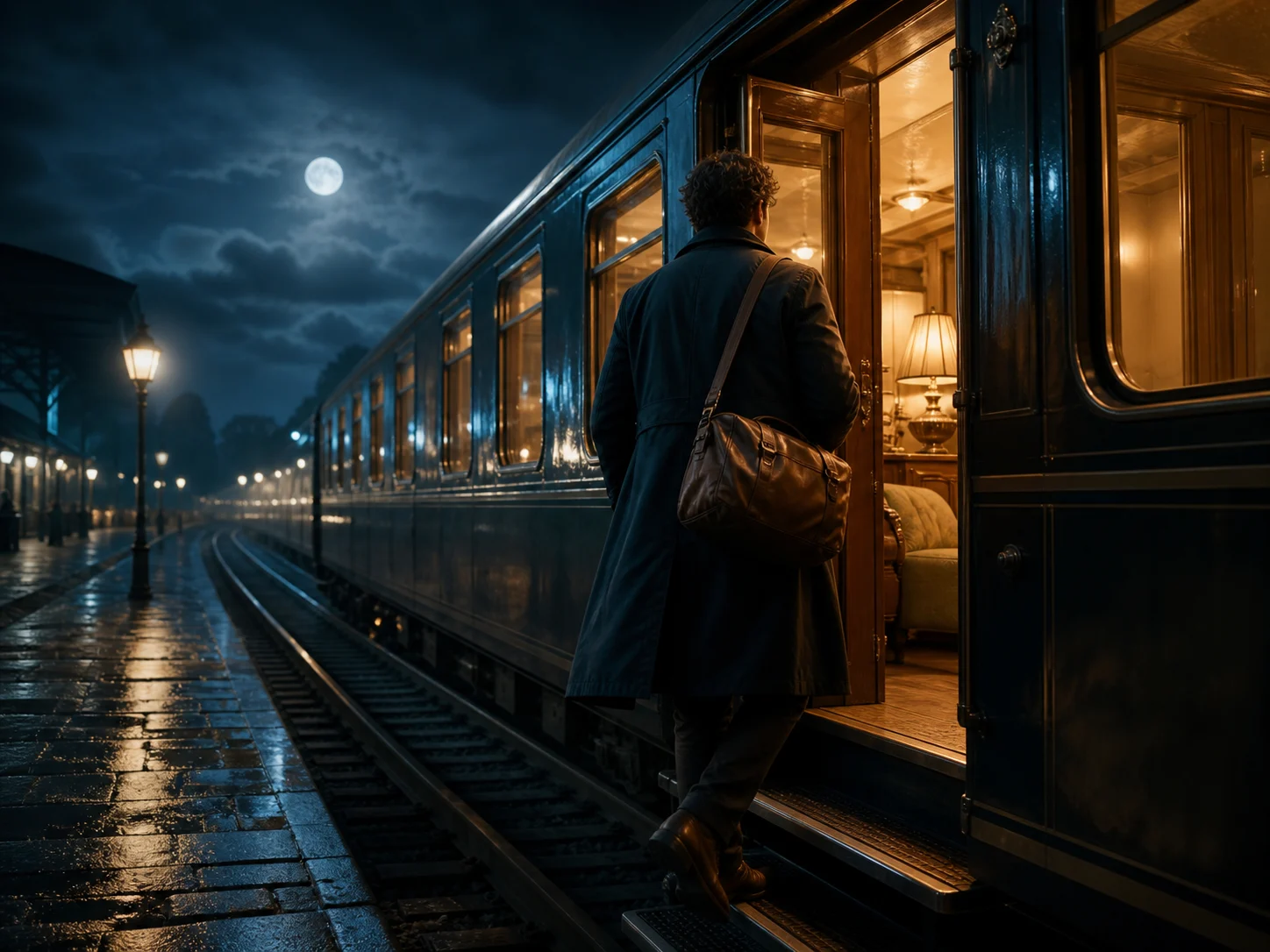
The main difference between Seedance 2.5 and Seedance 2.0 is the size of the job each version can handle in one workflow.
Seedance 2.5 is the better starting point for a scene longer than 15 seconds, a reference-heavy brief, or an edit to an existing video. Seedance 2.0 still makes sense for shorter work, especially when a hosting platform offers a delivery setting you need.
That answer covers most projects. The rest of this comparison explains where it comes from, which claims belong to the models, and which depend on the product hosting them.
Seedance 2.5 vs Seedance 2.0 at a glance
| Difference | Seedance 2.5 | Seedance 2.0 |
|---|---|---|
| Maximum single generation | Up to 30 seconds | Up to 15 seconds |
| Reference workflow | Built for larger multimodal briefs; current limits depend on the host product | Up to 9 images, 3 videos, and 3 audio files in ByteDance’s launch workflow |
| Editing | Broader audio and visual editing requests, plus production controls | Targeted video editing and continuation at the model level |
| Audio | Joint audio-video generation | Joint audio-video generation with documented dual-channel audio |
| Best starting point | Longer, reference-heavy, or edit-led work | Shorter work with a stable existing workflow |
These are not all the settings a reader will see in every interface. ByteDance’s Seedance 2.5 model page documents core model capabilities. Products such as Nuzza and Dreamina decide which operations, limits, resolutions, and beta features to expose.
What is Seedance 2.0?
Seedance 2.0 established the multimodal workflow that both versions share. It accepts text, image, video, and audio inputs, then uses those materials to guide composition, subject appearance, movement, camera language, and sound.
ByteDance’s official launch article specifies up to 9 images, 3 video clips, and 3 audio clips at once. It also documents 15-second audio-video output, targeted video editing, and video continuation.
That makes Seedance 2.0 more than an old text-to-video model. It can still be the sensible choice when the shot fits inside 15 seconds, the reference package is small, and the existing workflow already produces usable results.
What changed in Seedance 2.5?
Seedance 2.5 expands the same production model in three useful directions:
- a single generation can run for up to 30 seconds;
- reference-video understanding and audio-visual editing are broader;
- production controls now include workflows such as white-model guidance, green-screen editing, camera blocking, and performance blocking.
ByteDance also says a result can be extended twice. That gives creators more room to hold an action or narrative beat before planning a cut.
Some larger numbers associated with Seedance 2.5 belong to a product, not the core model page. Dreamina’s Seedance 2.5 page, for example, currently advertises up to 50 multimodal references and 4K output. Those are Dreamina’s current product claims and should not be treated as universal limits for every Seedance 2.5 integration.
How do Seedance 2.5 and Seedance 2.0 differ?
Clip length and story structure
Seedance 2.5 can generate up to 30 seconds in one pass. Seedance 2.0 stops at 15 seconds.
The practical difference is not simply “twice as long.” A 24-second action made with Seedance 2.0 needs at least two clips. The creator must choose a handoff frame, hide the cut, and manage changes in face, costume, props, eye line, and camera direction. Seedance 2.5 can attempt the same action without that join.
Longer generation introduces its own risk. More screen time gives identity, anatomy, object position, and audio timing more opportunities to drift. A 30-second setting is useful when the story needs it, not as a default for every product reveal or camera move.
A field example shows what the longer format can unlock. In a LinkedIn breakdown, Paolo Gavazza discusses a Seedance 2.5 gala video originally shared on X by @alisaqqt: a 30-second single take with seven characters, a detailed room, props, and 18 references. It is not a controlled benchmark, but it is a useful production example of a scene that would be awkward to split into two independent generations.
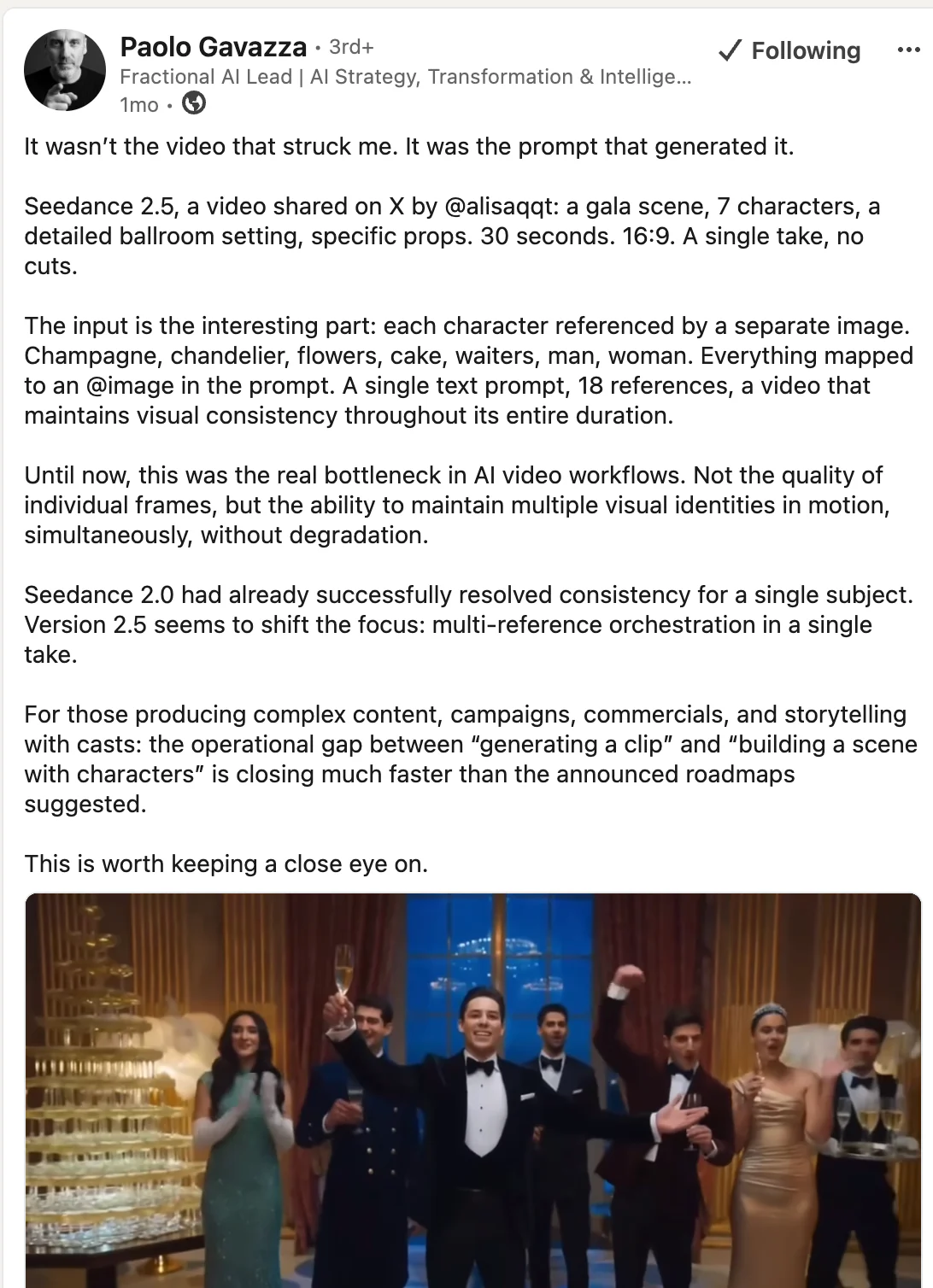
Paolo Gavazza’s LinkedIn post attributes the 30-second, seven-character gala scene to @alisaqqt on X and lists 18 references. View the source post.
Reference inputs and control
Seedance 2.0’s launch workflow has explicit limits: 9 images, 3 videos, and 3 audio clips. Seedance 2.5 is designed for larger briefs, while the exact allowance depends on the host product. Dreamina and Nuzza currently expose workflows with up to 50 combined reference files.
The value of those extra slots appears in scenes with several characters, product angles, wardrobe details, camera references, or a separate audio guide. More references do not guarantee better adherence. Each file needs a clear job.
That conclusion also appears in creator workflows. Theoretically Media’s early review builds a short film from reference images, documents roughly 15 generations and several continuity corrections, and includes a 50-reference wardrobe test. The larger input package expanded what the creator could specify, but it did not remove iteration or failure cases. The video’s description contains affiliate links, so its results are best treated as an experienced creator’s observations rather than a neutral benchmark.
A practitioner guide from ChatCut on X makes the workflow advice more concrete: assign each reference to an identity, object, style, movement, camera, or sound instruction. That is a better use of 20 files than attaching 20 loosely related examples.
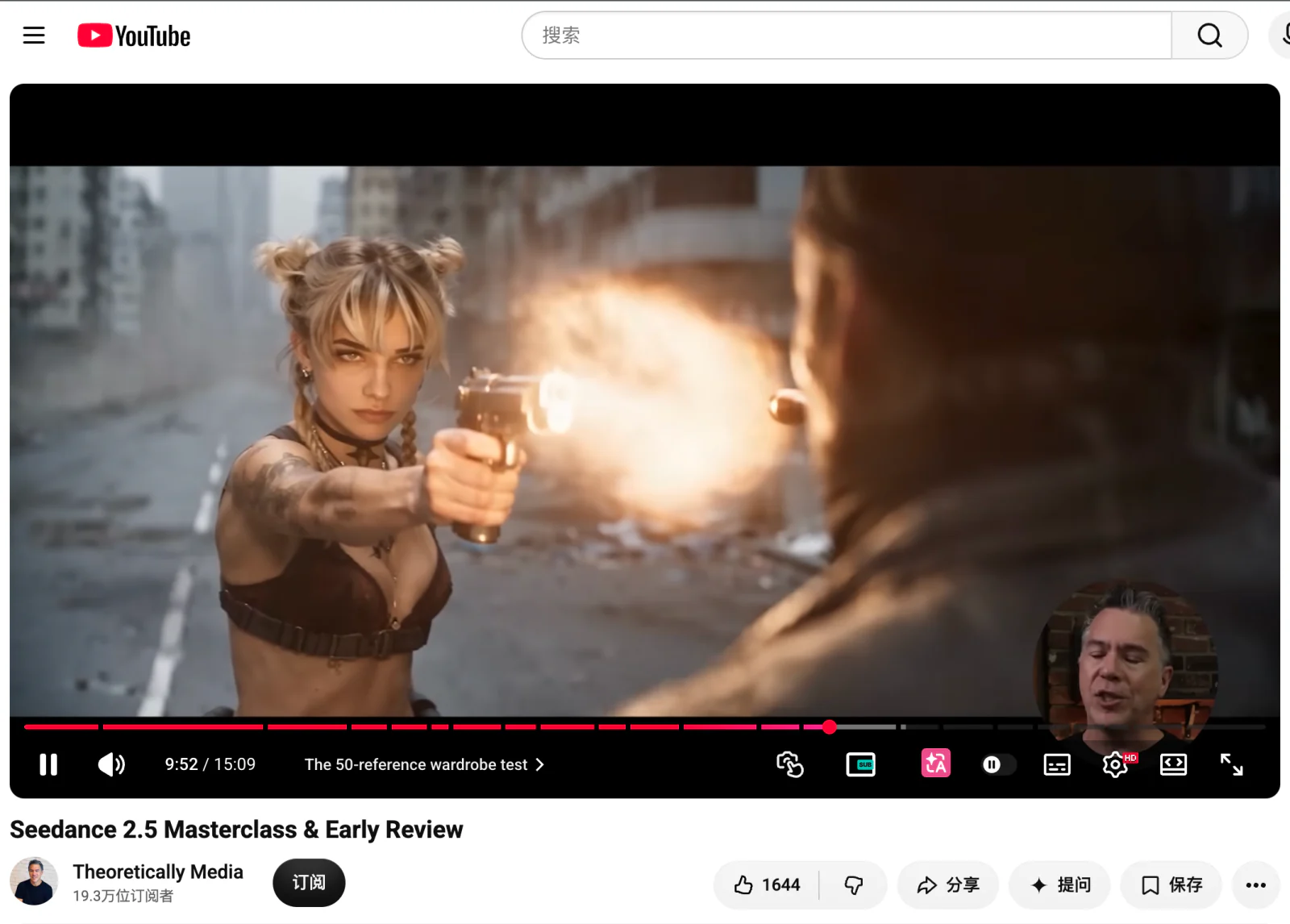
At 9:52, Theoretically Media labels this segment “The 50-reference wardrobe test.” The screenshot documents the creator’s stated test scope, not an official benchmark. Watch the source video.
Editing and continuation
Both versions support more than generation. Seedance 2.0’s launch article documents targeted changes to clips, characters, actions, and storylines, along with video continuation. Seedance 2.5 is positioned as the broader editing model, with more reliable responses to audio and visual edit requests.
This is one area where the hosting product matters. Nuzza currently exposes a dedicated Seedance 2.5 Video Edit workflow, while its Seedance 2.0 workspace focuses on generation and reference-led creation. A user who needs to change one object, replace part of an action, or preserve an approved camera move can therefore reach that operation more directly with Seedance 2.5 on Nuzza.
Theoretically Media’s workflow includes corrections and editing after generation. Runway’s official Seedance 2.5 demo also presents editing and extension as part of its hosted implementation. Together, these examples show how the capability enters a workflow; they do not establish that every edit will preserve every untouched detail.
The Nuzza screenshot below records the model’s reference-led creation entry point. It is product context rather than evidence of a successful edit.
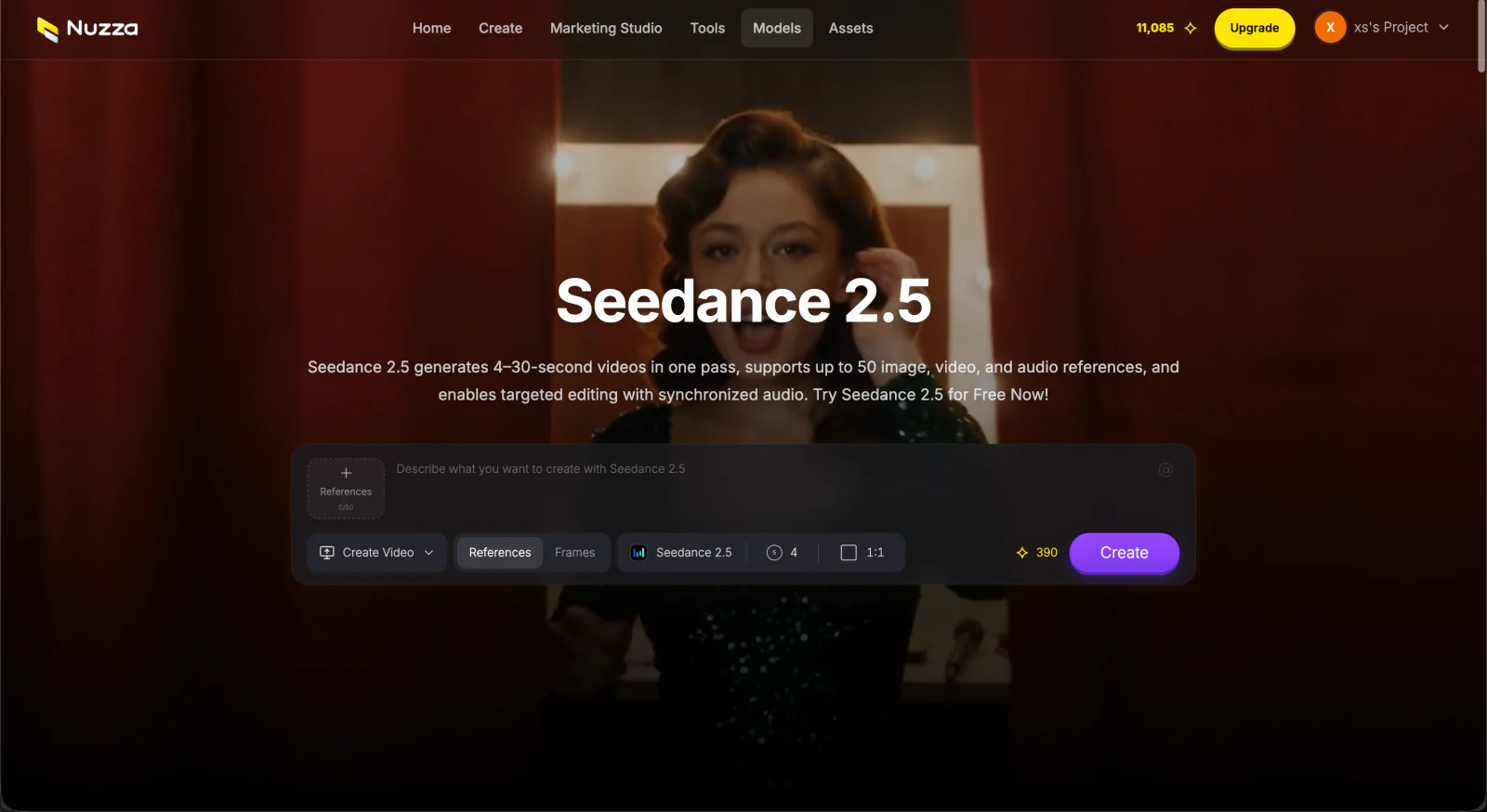
Nuzza’s Seedance 2.5 model page places a reference-led creation workspace directly below the model overview. Open the Seedance 2.5 workspace.
Audio
Both versions generate audio with video. ByteDance describes Seedance 2.0 as a dual-channel audio model that can combine dialogue, ambience, effects, and music. Seedance 2.5 remains an audio-video joint generation model and adds broader audio editing requests.
The public specifications do not establish a simple cross-version winner for audio quality. A useful comparison needs the same scene, words, speakers, timing, and audio references. Review the complete clip for speaker assignment, lip sync, ambient continuity, pronunciation, and whether a longer scene keeps sound aligned through the final seconds.
Dom the AI Tutor’s version comparison declares a test set of 34 videos from 17 prompts. That scope makes it a useful place to inspect repeated behavior across matched prompts. The method is creator-defined, so any quality ranking should remain attributed to the video rather than presented as an official benchmark.
Resolution and platform availability
Resolution is the clearest example of a platform setting being mistaken for a model limit.
As checked on August 17, 2026, Nuzza offers 480p, 720p, 1080p, and 4K for Seedance 2.0, while Seedance 2.5 offers 480p, 720p, and 1080p. Dreamina advertises 4K output for Seedance 2.5. The difference describes the current integrations, not a contradiction in the underlying model.
Check the visible controls in the product you plan to use. If direct 4K delivery is a hard requirement on Nuzza, Seedance 2.0 may be the practical starting point. If a 20- or 30-second take is harder to reconstruct after generation, Seedance 2.5 may still be worth choosing with an upscaling step planned afterward.
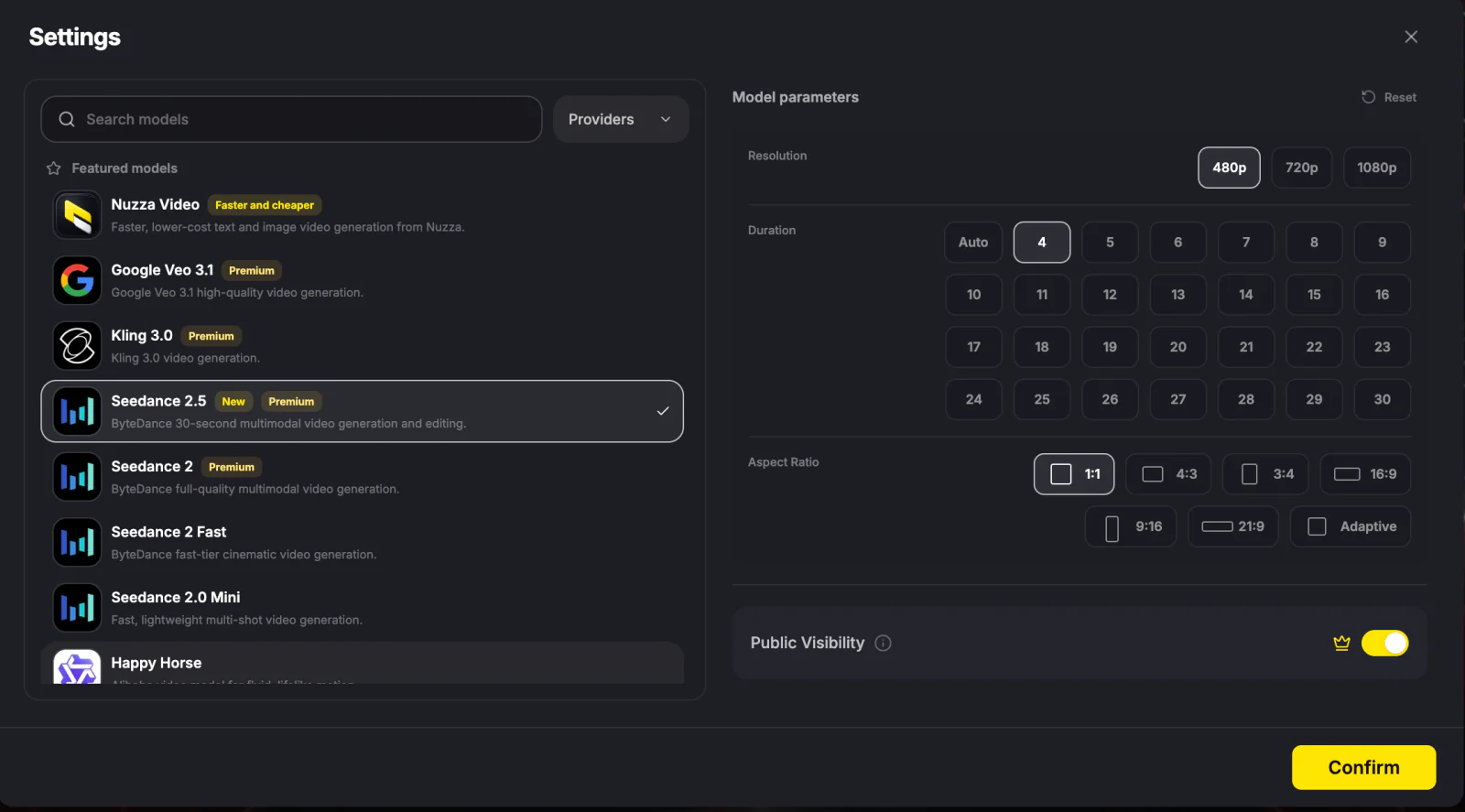
Nuzza’s Seedance 2.5 settings show 480p, 720p, and 1080p alongside duration choices from 4 to 30 seconds. Captured August 17, 2026.
Which version should you use?
Start with the constraint that would be hardest to fix after generation.
| Project requirement | Start with | Reason |
|---|---|---|
| One scene needs more than 15 seconds | Seedance 2.5 | It can hold the action in one generation |
| Many characters, products, motion, and audio references | Seedance 2.5 | The larger reference workflow leaves room for a structured brief |
| A precise change to an approved source video | Seedance 2.5 | The dedicated edit workflow reduces the need to regenerate accepted work |
| A short clip needs 4K directly from Nuzza | Seedance 2.0 | That setting is available in the current Nuzza integration |
| A simple shot already works in 15 seconds | Seedance 2.0 or a matched test | The newer version may not remove a real constraint |
Use the Seedance 2.5 workspace when duration, references, or editing define the job. Check Seedance 2.0 when the scene is short and a current platform setting matters more.
Should an existing Seedance 2.0 project move to 2.5?
Move when Seedance 2.5 removes a constraint that is already costing time: forced cuts, an overloaded reference brief, or full regeneration for a small change. Stay with Seedance 2.0 when the current shots work, the delivery settings fit, and migration would only replace a known workflow with new variability.
For an uncertain project, run one matched comparison. Use the same source assets, prompt, duration, aspect ratio, resolution, and audio setting where both products allow it. Save every attempt and compare complete clips for identity, requested action, camera continuity, audio timing, and attempts required to reach a usable result.
The test does not need to be ours to be useful. Dom the AI Tutor’s 34-video comparison can provide an external reference when its prompt matches the reader’s use case. A project-specific test is still stronger when the decision depends on a particular face, product, movement, or line of dialogue.
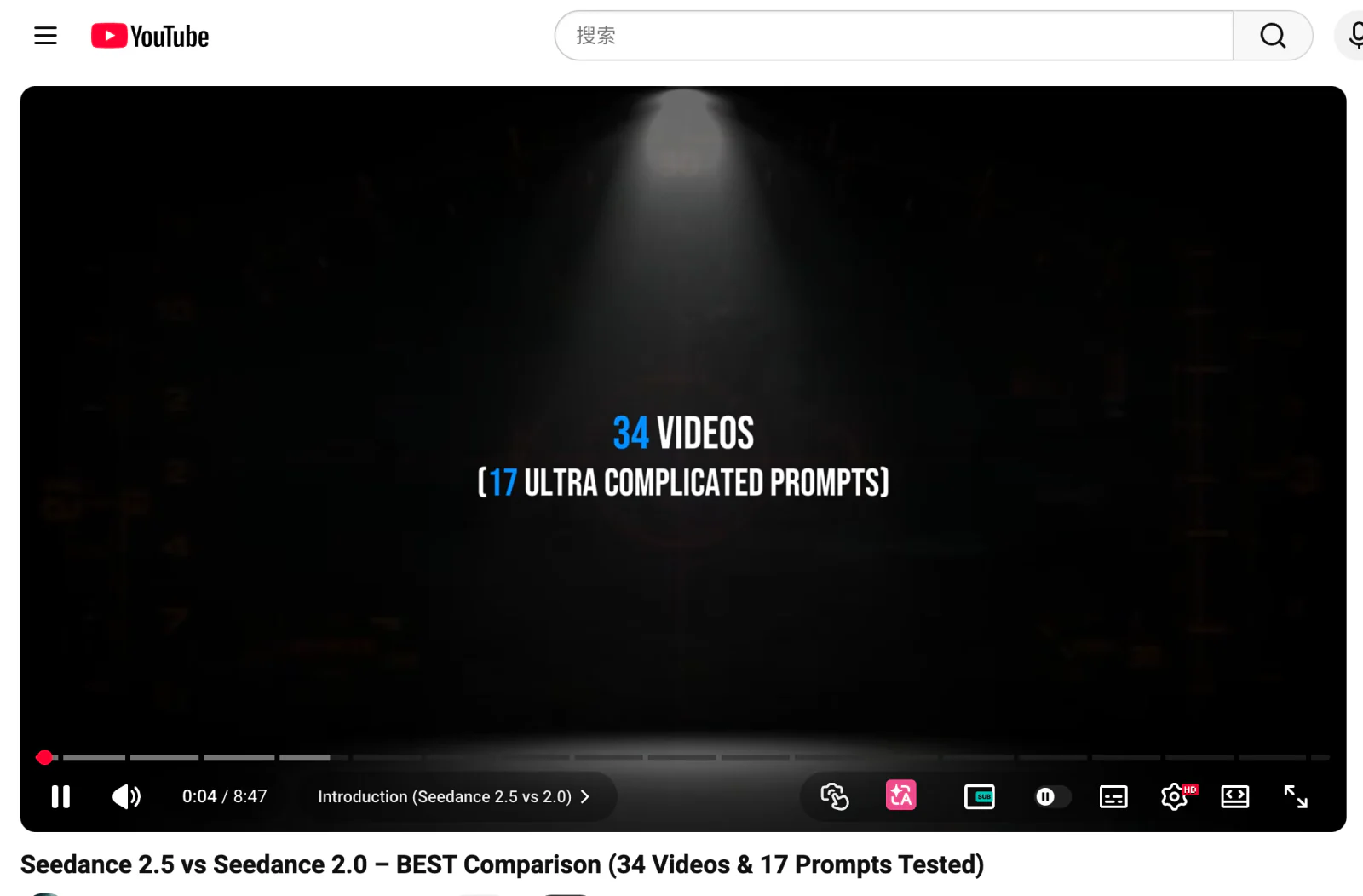
Dom the AI Tutor states that the comparison covers 34 videos generated from 17 prompts. The method and conclusions remain creator-defined. Watch the source comparison.
Frequently asked questions
Is Seedance 2.5 always better than Seedance 2.0?
No. Seedance 2.5 removes more constraints around duration, large reference briefs, and editing. Seedance 2.0 can remain the better operational choice for a short, stable workflow or a platform-specific output setting.
Does Seedance 2.5 support 4K?
It depends on the product. Dreamina currently advertises 4K Seedance 2.5 output. As checked on August 17, 2026, Nuzza exposes 480p, 720p, and 1080p for Seedance 2.5. Check the interface you will use before planning delivery.
Can Seedance 2.0 edit video?
Yes at the model level. ByteDance documents targeted editing and continuation for Seedance 2.0. A hosting product may or may not expose those operations in its interface.
Can both versions generate audio?
Yes. Both are audio-video joint generation models. Specifications alone do not prove which version will handle a particular voice, language, music cue, or sync requirement better, so use a matched example for audio-sensitive work.
Sources
- ByteDance Seed: Seedance 2.5 model overview. Official model source for 30-second generation, extension, reference understanding, editing, and production controls. Accessed August 16, 2026.
- ByteDance Seed: Seedance 2.0 model overview. Official model source for multimodal audio-video generation and reference control. Accessed August 16, 2026.
- ByteDance Seed: Seedance 2.0 official launch. Official launch source for input limits, 15-second output, editing, continuation, and audio. Published February 12, 2026.
- Dreamina: Seedance 2.5 AI Video Generator. Official product source for Dreamina’s current reference and output options. Accessed August 16, 2026.
- Theoretically Media: Seedance 2.5 Masterclass & Early Review. Independent workflow review covering a short-film process, iterations, corrections, and a 50-reference wardrobe test. The description contains affiliate links.
- Dom the AI Tutor: Seedance 2.5 vs Seedance 2.0. Independent, creator-defined comparison declaring 34 videos across 17 prompts.
- Paolo Gavazza on LinkedIn: a 30-second, 18-reference gala example. Practitioner commentary on a video originally shared on X by @alisaqqt.
- ChatCut on X: Seedance reference workflow guide. Practitioner guidance for assigning explicit roles to multimodal references.
- Runway: Seedance 2.5 is now available on Runway. Official hosted-platform demonstration of reference-led creation, editing, and extension.
Create longer, more controlled videos with Seedance 2.5
Try Seedance 2.5